
Peanut butter filling machine plays an important role in food processing industry, and its filling accuracy directly affects product quality and consumer satisfaction. For manufacturers relying on a peanut butter machine for large-scale production, understanding the factors that influence filling precision is essential for improving production efficiency, reducing waste, and maintaining consistent product quality. This article explores the key factors affecting the filling accuracy of peanut butter filling machines and offers professional guidance on how to optimize each one.
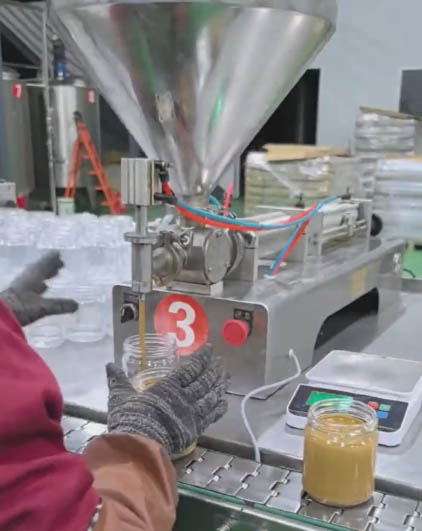
1. Material Characteristics: Viscosity and Rheology of Peanut Butter
The viscosity of peanut butter is one of the most critical factors affecting filling accuracy. Peanut butter is a non-Newtonian fluid with high viscosity and yield stress, meaning its flow behavior changes under different shear rates. This characteristic can easily lead to uneven flow during filling, resulting in inaccurate filling quantities.
To overcome this challenge, adjustments to the peanut butter filling machine are usually necessary. Common solutions include:
- Increasing the agitator speed to maintain homogeneity and prevent sedimentation
- Adjusting the opening and closing speed of the filling valve to ensure uniform flow
- Using a progressive cavity pump or rotary lobe pump designed for high-viscosity products
- Implementing a hopper with temperature control to maintain consistent product consistency
Understanding the rheological properties of peanut butter allows operators to fine-tune the peanut butter machine for optimal filling performance.
2. Equipment Performance: Precision Sensors and Control Systems
The accuracy and stability of the peanut butter filling machine itself directly influence filling results. High-precision sensors and advanced control systems—such as PLC (Programmable Logic Controller) and servo-driven filling mechanisms—can monitor and control every step of the filling process, significantly improving accuracy.
Key equipment features that enhance filling precision include:
- High-resolution load cells and flow meters for real-time feedback
- Servo-controlled filling nozzles for precise volume dispensing
- Anti-drip filling valves to prevent product waste and contamination
- Stable machine construction to minimize vibration and mechanical errors
In addition, the stable performance of the peanut butter machine reduces vibration and systematic errors, ensuring that each filling cycle is consistent and reliable. Regular calibration of sensors and control systems is also recommended to maintain long-term accuracy.
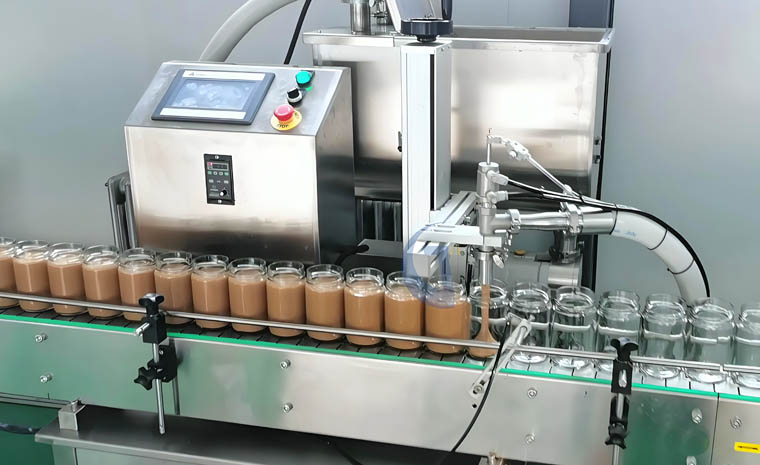
3. Temperature Control: Maintaining Optimal Fluidity
Temperature is a factor that cannot be ignored in peanut butter filling. The fluidity of peanut butter changes significantly at different temperatures. If the temperature is too high, peanut butter may become too thin and runny, leading to overfilling or leakage. If the temperature is too low, it may become too sticky and difficult to pump, causing underfilling or nozzle clogging.
Therefore, maintaining the proper temperature throughout the filling process is essential for ensuring the fluidity and filling accuracy of peanut butter. Recommended practices include:
- Jacketed hoppers and pipelines with circulating water or oil heating
- In-line temperature sensors for real-time monitoring
- Pre-heating peanut butter to a consistent temperature (typically 25–35°C, depending on formulation) before filling
- Insulated filling nozzles to prevent temperature fluctuation during dispensing
Proper temperature management not only improves filling accuracy but also extends the lifespan of the peanut butter filling machine.
4. Cleaning and Maintenance: Preventing Contamination and Blockages
Cleaning and maintenance of equipment are equally important. Residues or impurities may block the filling pipeline or valve, thus affecting the filling accuracy. Therefore, cleaning and maintaining the equipment regularly can not only prolong the service life of the equipment, but also ensure the smooth filling process.
5. Operator Skills: Training and Process Control
Finally, the skill level of operators also affects filling accuracy. Skilled operators can quickly identify and resolve issues during the filling process—such as detecting inconsistent flow, adjusting parameters, and performing minor troubleshooting—thereby reducing errors and improving production efficiency.
Conclusion
To sum up, to improve the filling accuracy of peanut butter filling machine, many factors need to be comprehensively considered, including material characteristics, equipment performance, environmental conditions, equipment cleaning and maintenance, and operator skills. By continuously optimizing these factors, the product quality can be effectively improved to meet the market demand.
For businesses looking to enhance their peanut butter production lines, investing in a high-quality peanut butter machine with advanced control systems and reliable temperature management—combined with proper maintenance and operator training—is the key to achieving consistent, accurate filling and long-term success in the competitive peanut butter market.